
Speeding the Shift and Understanding the GMPs

Clinical to Commercial Journey

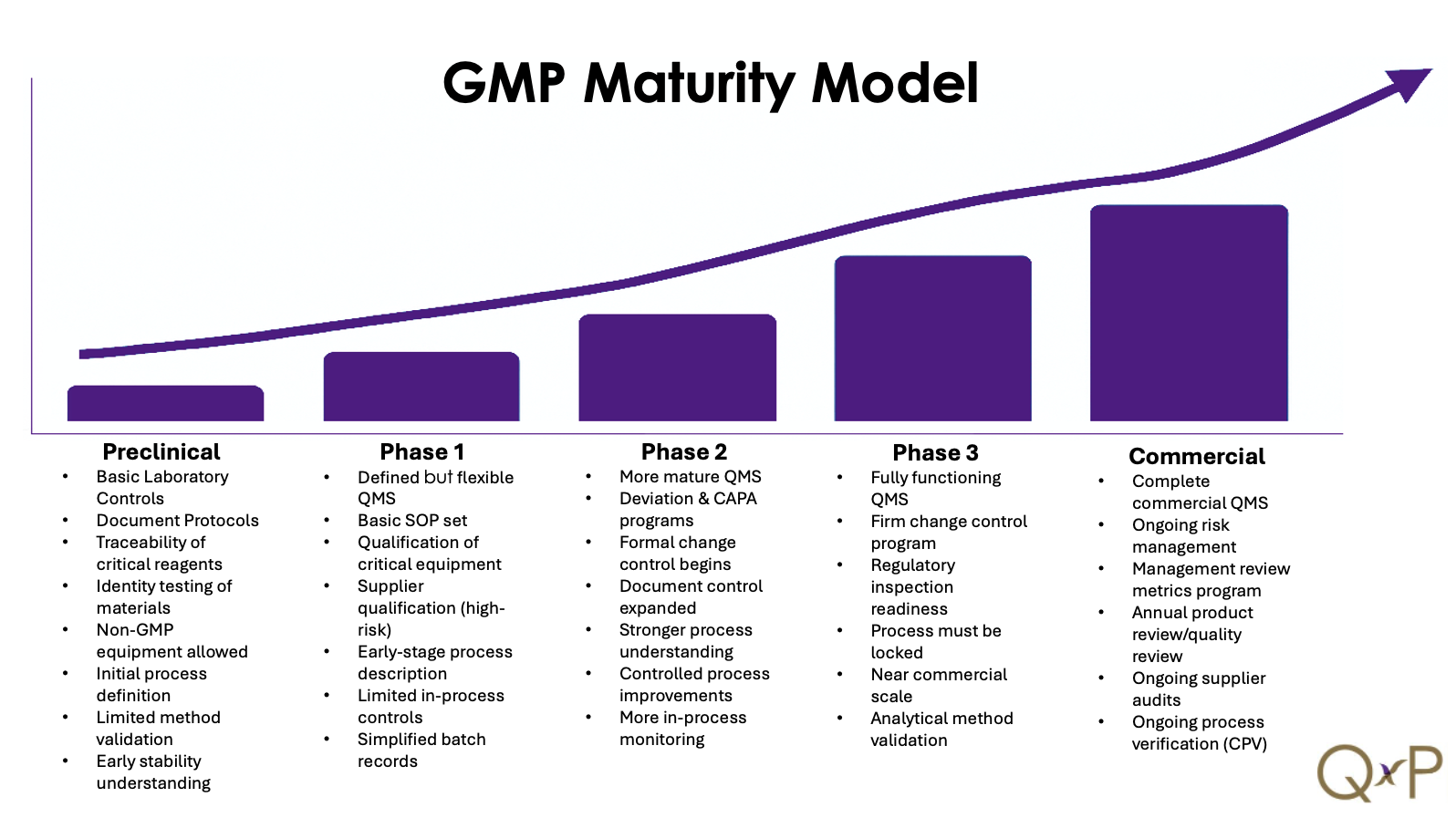
Implementing a phase-appropriate GMP (Good Manufacturing Practice) system from clinical development to commercial production presents a range of technical, regulatory, and operational challenges, especially in highly regulated industries like pharmaceuticals and biotech. Below are the key challenges:

1. Scalability and Process Evolution

  • Early clinical phases (Phase I/II) focus on small-scale, flexible processes to support rapid iteration and safety assessments.
  • As development progresses, processes must scale for Phase III and commercial supply, often requiring technology transfer, process validation, and equipment upgrades.
  • Challenge: Balancing process flexibility in early phases with the robustness and reproducibility required for commercial manufacturing.

2. Evolving Regulatory Expectations

  • GMP requirements increase with each phase:
  • Phase I: Emphasis on documentation and patient safety.
  • Phase III: More stringent controls, qualification of equipment, and data integrity.
  • Commercial: Full compliance with ICH Q8–Q10, FDA/EU GMPs, and inspection readiness.
  • Challenge: Implementing systems that are compliant yet scalable, without over-investing too early.

3. Quality System Maturity

  • Early-stage companies often operate with lean quality systems.
  • Transition to later phases requires:
  • Formal Change Control
  • Deviation and CAPA management
  • Supplier qualification
  • Robust document control and training
  • Challenge: Scaling the quality management system (QMS) without disrupting operations or delaying timelines.

4. Data Integrity and Electronic Systems

  • Manual or hybrid systems may suffice in early stages but become inadequate for handling the volume and complexity of data in late-stage development.
  • Transitioning to validated electronic systems (e.g., LIMS, QMS, MES) is resource-intensive.
  • Challenge: Timing and validation of these systems while ensuring continuity of compliance.

5. Technology Transfer and Site Readiness

  • Moving from clinical to commercial often involves:
  • Transferring processes to CMOs/CDMOs or in-house commercial sites
  • Ensuring consistent documentation, training, and equipment qualification
  • Challenge: Maintaining GMP continuity and comparability of product through each transfer.

6. Cross-Functional Coordination

  • Requires alignment across R&D, Quality, Regulatory, Manufacturing, and Supply Chain.
  • Challenge: Avoiding silos and ensuring that decisions are made with an understanding of future commercial implications.

7. Cost and Resource Allocation

  • Phase-appropriate GMP aims to optimize resources by applying only what’s necessary for a given phase.
  • However, under-investing early may lead to costly rework or regulatory delays later.
  • Challenge: Finding the right balance between risk and compliance.

8. Cultural and Organizational Readiness

  • Start-ups or early-phase companies often have a research-centric culture.
  • Moving to commercial requires a compliance-driven culture, formal training, and operational discipline.
  • Challenge: Managing change management and training across teams and sites.
Achieving full GMP compliance through validated, reproducible processes and systems—while ensuring alignment with regulatory expectations for commercial readiness is the most challenging journey you will take.  QxP has many experts to help take you there.  We have helped many to achieve their commercial success quicker and more cost effective than doing this alone.  Call us!

Implementing a phase-appropriate GMP (Good Manufacturing Practice) system from clinical development to commercial production presents a range of technical, regulatory, and operational challenges, especially in highly regulated industries like pharmaceuticals and biotech. Below are the key challenges:

1. Scalability and Process Evolution

  • Early clinical phases (Phase I/II) focus on small-scale, flexible processes to support rapid iteration and safety assessments.
  • As development progresses, processes must scale for Phase III and commercial supply, often requiring technology transfer, process validation, and equipment upgrades.
  • Challenge: Balancing process flexibility in early phases with the robustness and reproducibility required for commercial manufacturing.

2. Evolving Regulatory Expectations

  • GMP requirements increase with each phase:
  • Phase I: Emphasis on documentation and patient safety.
  • Phase III: More stringent controls, qualification of equipment, and data integrity.
  • Commercial: Full compliance with ICH Q8–Q10, FDA/EU GMPs, and inspection readiness.
  • Challenge: Implementing systems that are compliant yet scalable, without over-investing too early.

3. Quality System Maturity

  • Early-stage companies often operate with lean quality systems.
  • Transition to later phases requires:
  • Formal Change Control
  • Deviation and CAPA management
  • Supplier qualification
  • Robust document control and training
  • Challenge: Scaling the quality management system (QMS) without disrupting operations or delaying timelines.

4. Data Integrity and Electronic Systems

  • Manual or hybrid systems may suffice in early stages but become inadequate for handling the volume and complexity of data in late-stage development.
  • Transitioning to validated electronic systems (e.g., LIMS, QMS, MES) is resource-intensive.
  • Challenge: Timing and validation of these systems while ensuring continuity of compliance.

5. Technology Transfer and Site Readiness

  • Moving from clinical to commercial often involves:
  • Transferring processes to CMOs/CDMOs or in-house commercial sites
  • Ensuring consistent documentation, training, and equipment qualification
  • Challenge: Maintaining GMP continuity and comparability of product through each transfer.

6. Cross-Functional Coordination

  • Requires alignment across R&D, Quality, Regulatory, Manufacturing, and Supply Chain.
  • Challenge: Avoiding silos and ensuring that decisions are made with an understanding of future commercial implications.

7. Cost and Resource Allocation

  • Phase-appropriate GMP aims to optimize resources by applying only what’s necessary for a given phase.
  • However, under-investing early may lead to costly rework or regulatory delays later.
  • Challenge: Finding the right balance between risk and compliance.

8. Cultural and Organizational Readiness

  • Start-ups or early-phase companies often have a research-centric culture.
  • Moving to commercial requires a compliance-driven culture, formal training, and operational discipline.
  • Challenge: Managing change management and training across teams and sites.

Achieving full GMP compliance through validated, reproducible processes and systems—while ensuring alignment with regulatory expectations for commercial readiness is the most challenging journey you will take.  QxP has many experts to help take you there.  We have helped many to achieve their commercial success quicker and more cost effective than doing this alone.  Call us!

Regulatory Readiness for Advanced Modalities

Christine Feaster
December 2, 2025

Regulatory Readiness for Advanced Modalities

Christine Feaster
November 20, 2025

Why Tech Transfer Fails at CDMOs

Drew Cullinane
November 19, 2025

The QxP Approach Makes the Difference

Elizabeth Thomae
November 18, 2025

America's Biomanufacturing Powerhouse

Christine Feaster
November 12, 2025

Client Retention Starts on Day 1

Drew Cullinane
November 6, 2025

From Executive Order to Execution

Christine Feaster
October 28, 2025

Regulatory and New Technology in the CDMO space

Christine Feaster
October 28, 2025

Rebuilding Where It Matters

Christine Feaster
October 20, 2025

Where Did Everyone Go?

Christine Feaster
October 14, 2025

How QxP Helps Companies Navigate FDA Complete Response Letters (CRLs)

Christine Feaster
October 3, 2025

Inspection Readiness as Competitive Advantage

Christine Feaster
October 1, 2025

Growing by Acquisition is (not) like shopping at IKEA

Mark Roache
August 6, 2025

Beyond the Audit

Christine Feaster
July 30, 2025

Threat or Promise?

Mark Roache
July 22, 2025

Why Education and Training Are Crucial for Indian Pharma

Christine Feaster
July 21, 2025

Strategic Support

Christine Feaster
July 11, 2025

Uncovering Hidden Risks and Value

Christine Feaster
July 7, 2025

Strategic role of Quality Executive Partners in FDA Pre-Meetings for Foreign and Domestic Manufacturers

Christine Feaster
July 3, 2025

The High-Performing Team

Mark Roache
July 2, 2025

Another failed CAPA

Mark Roache
June 19, 2025

Mastering the Molecular Maze

Christine Feaster
June 17, 2025

ADVANCING ONSHORING: Strengthening U.S. Pharma Through Innovation and Oversight

Mark Roache
Glenn Barbrey
May 27, 2025

Why You Need a Consultancy During Uncertain Times

Christine Feaster
May 23, 2025

Building Supplier Resilience Amid Onshoring and Tariff Risks

Christine Feaster
May 19, 2025

Virtual Reality - Reshaping Education Across the Pharmaceutical Landscape.

Christine Feaster
May 14, 2025

Transferring Success: Best Practices for Pharma Onshoring

Christine Feaster
May 6, 2025

Quality Metrics in Pharma

Christine Feaster
May 2, 2025

The Value Of Quality

Mark Roache
May 2, 2025

From CRL to Approval: QxP Navigates FDA Feedback with Timeliness and Precision

Christine Feaster
April 24, 2025

Training for Impact and Excellence

Sarah Boynton
April 15, 2025

Deviation and OOS Investigations in Pharmaceutical Manufacturing

Tamer Helmy, PhD
April 10, 2025

Is Your Contamination Control Strategy Delivering What It Should?

Christine Feaster
April 9, 2025

The Hallmarks of a Successful Pharma Consultancy

Christine Feaster
January 14, 2025

Pharmaceutical Predictions for 2025

Christine Feaster
December 11, 2024

The Crucial Nexus: Data Integrity in Pharmaceutical Manufacturing

Christine Feaster
May 17, 2024

Pharmaceutical Industry Trends for 2024 So Far

Christine Feaster
April 24, 2024

Decoding the Technical Transfer Process in Biotech Manufacturing

Sarah Boynton
April 23, 2024

Quality Executive Partners - IACET Accreditation

Ken Mead
April 9, 2024

Coaching and Correcting: A Focus on Behavior Over Blame

Sarah Boynton
November 1, 2023

The Importance of Roles and Responsibilities in Biotech Manufacturing & Human Error Prevention

Sarah Boynton
October 26, 2023

Remote cGMP Inspections and AI in Drug Manufacturing

Michelle Fishburne
October 11, 2023

4 Best Practices for Effective Investigation into Deviations

Sarah Boynton
September 19, 2023

The Art of Viral Vector Manufacturing: 4 Essential Controls to Prevent Cross-Contamination

Sarah Boynton
September 13, 2023

Practicing Risk Acceptance

Mark Roache
August 28, 2023

Annex 1 – Can we all take a deep breath now?

Vanessa Figueroa
August 24, 2023

In Cell and Gene, Good Science is Necessary, But Not Sufficient

Mark Roache
August 21, 2023

6 Ways To Achieve Manufacturing Audit And Inspection Readiness

Sarah Boynton
August 14, 2023

Experience is What You Get Just After You Needed It, Part 1

Mark Roache
August 10, 2023

Experience is What You Get Just After You Needed It, Part 2

Mark Roache
August 10, 2023

Sterility Assurance Matters to This ONE

Greg Gibb
August 8, 2023

Enhancing Quality and Safety: 3 Essential Human Error Prevention Tools for cGMP Manufacturing

Sarah Boynton
August 3, 2023

Asia-Pacific Happenings: Samsung Bioepis Implements QxP Virtuosi®

Michelle Fishburne
August 2, 2023

CDMOs – Selecting the Right One for Each Manufacturing Stage

Christine Feaster
July 24, 2023

3 Types of Human Error and Potential CAPAs to Prevent Them

Sarah Boynton
July 20, 2023

Drug Shortages: Causes & Solutions

Christine Feaster
July 10, 2023

The 5 Questions You Need to Ask After a Human Error Event Occurs

Sarah Boynton
July 5, 2023

Understanding How Adults Learn

Mike Levitt
June 30, 2023

Annex 1 and Ensuring Filling Technologies Fit the Need

Natasha Howard
June 21, 2023

How to Solve Pharma’s Skilled Workforce Deficit

Jeff Roy
June 20, 2023

ChatGPT Told Me AI is “Imperative” in Pharma Manufacturing

No items found.
June 18, 2023

Get Ready: FDORA’s Unannounced Foreign Inspection Pilot Program is On!

Crystal Mersh
June 6, 2023

Nitrosamines Impurity Challenges

Christine Feaster
June 2, 2023

All You Need to Know About Contamination Control Strategies, Parts 1 and 2

No items found.
June 1, 2023

When is ISO 8 Not ISO 8?

Bob Ferer
May 30, 2023

Cost Of Quality: Worth Every Cent In Bio/Pharmaceutical Manufacturing

Crystal Mersh
May 24, 2023

Pharmaceutical Quality is NOT a Spectator Sport

Mike Levitt
May 22, 2023

The Six Keys for Effective Deviation Investigators

Mike Levitt
May 18, 2023

There Has to be a Better Way to Train

Tyler DeWitt, Ph.D.
May 15, 2023

Cell and Gene: Article Series on CGT’s Key Drivers

Mark Roache
May 8, 2023

Bacterial Endotoxin Testing is on the Move

Christine Feaster
May 5, 2023

Top 20 Pharma Company Chooses QxP Virtuosi® Platform

Vanessa Figueroa
May 3, 2023

Crystal Clear: Controls Are Not Enough

Crystal Mersh
April 22, 2023

Myth #2: Proactively Remediating Bad Inspection Outcomes: What’s the benefit?

Brian Duncan
April 20, 2023

Myth #1: Complying with Regulations and Product Specifications

Brian Duncan
April 20, 2023

Is it Time to Outsource Internal Auditing?

Mike Levitt
April 18, 2023

Quality is Number One, Even When Trying to Address Supply Chain Issues

Christine Feaster
April 14, 2023

Don’t Be a Daredevil When Retrofitting Your Facility, Part 1

Bob Ferer
April 10, 2023

Don’t Be a Daredevil When Retrofitting Your Facility, Part 2

Bob Ferer
April 10, 2023